
Dos Baushtibl
Yevgeniy Fiks
September 22 – December 7, 2025
H. Fisher & Fils
4129 boul. St-Laurent
UPCOMING EVENTS
Yevgeniy Fiks: Artist Talk and Workshop
Sunday, November 30, 2025
ARTIST
Yevgeniy Fiks
ARTISTIC DIRECTOR
Alyssa Stokvis-Hauer
CURATORS
Taryn Fleishchmann Austin Henderson
Alyssa Stokvis-Hauer
CONTRIBUTING ARTISTS
Asha Thomas-Paskal Ava Berkson
Chava Rosengarten Claudia Bulaievsky
Corbin Allardice Edith McCrea
Ila Novak Kelly Steinmetz Moyshe Schlerf
Rachel Leader Raia Gutman
Ruth Geye Sarah Bindel
GRAPHIC DESIGN
Austin Henderson
SCREEN PRINTING
Scott Osborne
TRANSLATION
Sebastian Shulman (Yiddish) Sophie Boivin-Joannette (French)
Special thanks go to Avia Moore, David Moss, Uri Schreter, and Pippa Bartlett for their support on this project.
A site-specific collaborative installation by New York-based conceptual artist Yevgeniy Fiks, Dos Baushtibl draws upon the design principles developed and taught by the Bauhaus to investigate what can or might make visual art ‘Yiddish.’
Yiddish is a language spoken primarily by Ashkenazi Jews, blending German, Hebrew, Slavic, and other regional linguistic influences. Like other Jewish diasporic languages such as Ladino (Judeo-Spanish), Judeo-Arabic, or Judeo-Persian, it is traditionally written using the Hebrew alphabet.
Originating around the 9th century AD, Yiddish became a vibrant language for everyday life, literature, and culture, and by the early 20th century was spoken by around 10–11 million people. This included large immigrant communities in North America. Historically, Montreal was one of these major Yiddish centres; in 1931, 99% of its Jewish community spoke Yiddish as their mother tongue.
Today, the number of active speakers has declined to fewer than a million worldwide, though it remains vital in some Jewish communities and cultural circles.
The Bauhaus was a school of art, design, and architecture founded in Weimar, Germany in 1919. The school pioneered a modern and avant-garde approach, emphasizing collaboration between artists and craftsmen, uniting fine art with practical design, and espousing principles of simplicity, geometry, and functionality. the Bauhaus ethos sought to bring beauty into everyday life through well-crafted, accessible objects.
The school became a center of modernist innovation, with influential artists such as founder Walter Gropius, Mies van der Rohe, Wassily Kandinsky, and Anni Albers teaching at the school. The faculty also included Jewish artists such as architects Marcel Breuer and painter/photographer László Moholy-Nagy.
In 1933, the Nazis forced the Bauhaus’ closure, condemning its internationalist and avant-garde ideals as “degenerate.” Many of its teachers emigrated to North America, where figures like Gropius, Moholy-Nagy, and van der Rohe reshaped art and design education, embedding Bauhaus principles at the core of modern art pedagogy.
What is a Yiddish Line, Yiddish Shape, Yiddish Color?
This conceptual project takes the form of a workshop that explores the foundations of two-dimensional design through the lens of Yiddish culture—and more specifically, Yiddish poetry.
Dos Baushtibl mimics the Basic Course of the Bauhaus, the famed modernist art school in Weimar Germany during the 1920s and ’30s, with its focus on visual fundamentals such as line, shape, form, and color.
There were a number of Yiddish-speakers in the historical Bauhaus in Weimar (mostly among the students). Dos Baushtibl pays tribute to that history and makes the Yiddish presence in the 20th-century modernist education project less inconspicuous. It adopts Bauhaus principles and uses them as a foundation for a distinctly Yiddish visual art.
The title Dos Baushtibl is a Yiddishized diminutive of “Bauhaus,” simultaneously mimicking and questioning the asymmetrical relationship between secular Jewish/Yiddish culture—especially visual art—and the grand traditions of European art.
Where does Yiddish visual art begin? Given the centrality of language in Yiddish culture, Dos Baushtibl uses Yiddish poetry as a point of departure. However, this project does not simply illustrate Yiddish literature. While recognizing the importance of language in Yiddish culture, Dos Baushtibl draws from Yiddish verse to create independent, stand-alone works of visual art.
Thus, Dos Baushtibl exists at the intersection of several contradictions:
- How can visual art be Yiddish when Yiddish is, first and foremost, a language?
- Can literature serve as a foundation for autonomous visual art?
- Can a project rooted in a mainly European artistic tradition achieve independence from that tradition—or will it always remain a provincial tag-along, a small-scale Yiddish “Bauhaus” following in the legendary institution’s footsteps, locked in an asymmetric relationship?
Can Yiddish visual art escape the hegemony of both Jewish literary tradition and the dominant European artistic legacy? Or can it draw from both and still claim autonomy and authenticity?
Dos Baushtibl is an experiment in search for formal autonomy in Yiddish visual art—a search that must begin with the basics: the foundations of visual art itself. It goes back to the fundamentals, beyond context, history, memory, and inherited do’s and don’ts.
Yiddish visual art begins at the beginning—with the basics of line, shape, form, and color.
YEVGENIY FIKS is a Moscow-born New York-based artist, author, and organizer of art exhibitions. Among his projects are “A Gift to Birobidzhan,” “Landscapes of the Jewish Autonomous Region,” and “Himl un erd (Yiddish Cosmos)” that have been exhibited at 2B Galeria, Budapest; Galerie Sator, Paris; 21ST.PROJECTS/Critical Practices Inc., New York; and CCI Fabrica, Moscow. Fiks’s performance pieces “Lily Golden, Harry Haywood, Langston Hughes, Yelena Khanga, Claude McKay, Paul Robeson, Robert Robinson on Soviet Jews” and “Red Kaddish” have been performed at the International Print Center New York and the Museum at Eldridge Street/A Landmark Synagogue Story, both in New York.
Fiks’s curatorial projects include “The Wayland Rudd Collection” at Winkelman Gallery, New York and First Floor Gallery Harare, Harare, Zimbabwe; “In Edenia, a City of the Future” at Yermilov Centre, Kharkiv, Ukraine (with Larissa Babij), “Monument to Cold War Victory” at The Cooper Union, New York (with Stamatina Gregory), and “Yiddishland Pavilion,” Venice, Italy and online (with Maria Veits). Fiks is the author of the programmatic essay “Yiddish Contemporary Art” that has appeared in Yiddish, English, Russian, Hungarian, Belarusian, Polish, and Slovak.
Yevgeniy Fiks’ process-driven work which led to the site-specific installation Dos Baushtibl or “the Little Bauhaus,” uses seven prompts created by the artist to play with the question: what can or might make visual art Yiddish? Each prompt is paired with a selection of Yiddish poems that relate or call to fundamental Bauhaus design elements:
- Line
- Shape
- Space
- Form & Value
- Contrast
- Balance
- Colour
- Gray
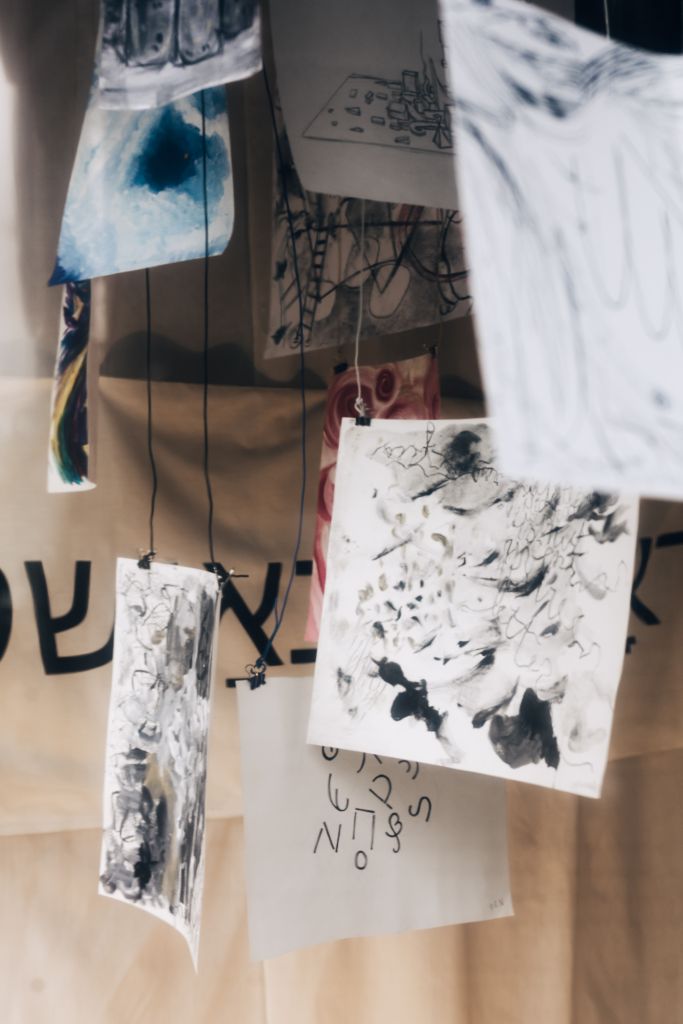
Drawing on these design principles, alongside the Bauhaus’ spirit of collaboration, and emphasis on accessibility, Fiks guided participants of KlezKanada’s Summer Retreat through the prompts, with the resulting artworks forming the basis of the installation. As seen in the vitrine display, the prompts and artistic responses to Line, Shape, Gray, and Colour together form a varied and layered body of work. Interspersed are Yevgeniy’s responses to his own prompts, and unremarkable art supplies and tools, each enigmatically bearing the name of a different Yiddish poet.
The sum of this collaborative piece is not only an invitation to consider what might make a line, shape, or colour Yiddish, but for anyone to participate in Dos Baushtibl by reading the poetry, and following the prompts themselves.
As a site-specific piece, Dos Baushtibl also acts as a kind of portal, calling to the Yiddish history of Montreal and the Plateau. Montreal has long been a centre of Yiddish life, with many noted writers (including poets like A.M. Klein, Chava Rosenfarb, and Melech Ravitch featured in Dos Baushtibl), thinkers (Ida Maze, J.I. Segal), and activists (Léa Roback, Hirsch Hershman) connected to this neighbourhood. From the early- to mid-20th century, the H. Fisher & Fils garment supply shop would have stood in the midst of a vibrant multi-lingual, and majority Jewish immigrant community. Yiddish would have been heard on most street corners, seen on signs, and featured in the front windows of stores all along St-Laurent. With Yevgeniy and his collaborators’ work, a little bit of Yiddish artistry is returned to the Main.
Dos Baushtibl continues the program of public art installations in the Fisher Vitrine drawing from Jewish culture and heritage as it relates to this celebrated storefront and the city it calls home.

This installation was produced under the Montreal Jewish Arts Collaborative (MJAC) granting initiative, made possible through the support of the Averbach Family Foundation, CANVAS, The Azrieli Foundation, and the Canadian Race Relations Foundation.