

Amour Toujours
Jennifer Jack
18 décembre 2025 – avril 2026
H. Fisher & Fils
4129, boul. Saint-Laurent
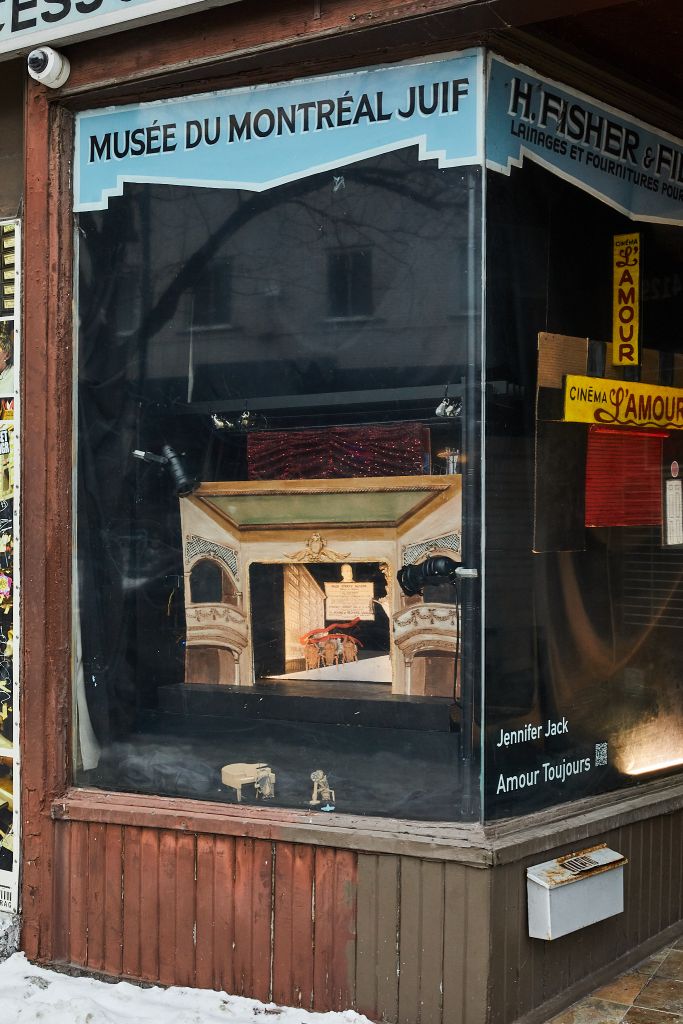
Photo : Laurence Poirier
ARTISTE
Jennifer Jack
TECHNICIEN•NE
Chloé Rivest
DIRECTRICE ARTISTIQUE
Alyssa Stokvis-Hauer
COMMISSAIRES
Taryn Fleischmann, Austin Henderson
Alyssa Stokvis-Hauer
Installation théâtrale jouet spécifique au site par Jennifer Jack, Amour Toujours est une exploration ludique de l’histoire du Cinéma L’Amour, ancien lieu de représentation de spectacles de vaudeville yiddish, et de sa place dans le corridor historiquement juif du boulevard Saint-Laurent.
Populaire du milieu du XIXe siècle au début du XXe siècle, la vaudeville était une forme de spectacle de variétés qui combinait burlesque, comédie et danse. Ses racines se trouvent dans ce que l’on appelle souvent les divertissements populaires « bas de gamme », tels que les attractions foraines, les numéros de cirque, les minstrels et les « dime museums ».
Dans le contexte juif nord-américain, le vaudeville a également intégré des éléments du théâtre yiddish, de la comédie musicale et des traditions comiques, devenant ainsi un moyen important pour les immigrants juifs européens de s’assimiler au Canada et aux États-Unis. Face aux nombreuses barrières préjudiciables auxquelles les juifs étaient confrontés dans leurs nouvelles communautés, le vaudeville yiddish leur offrait un espace particulier, un lieu de joie et d’évasion pour et par les juifs, dans leur propre langue.
Tout comme New York, Montréal était un pôle important pour le vaudeville yiddish (et le vaudeville en général), offrant des salles yiddish très prisées telles que Le Monument-National (aujourd’hui l’École nationale de théâtre) et Le Globe (aujourd’hui le Cinéma L’amour).
Le yiddish est une langue parlée principalement par les juifs ashkénazes, mélangeant des influences linguistiques allemandes, hébraïques, slaves et autres influences régionales. Comme d’autres langues diasporiques juives telles que le ladino (judéo-espagnol), le judéo-arabe ou le judéo-persan, il s’écrit traditionnellement à l’aide de l’alphabet hébreu.
Apparu vers le IXe siècle, le yiddish est devenu une langue vivante utilisée dans la vie quotidienne, la littérature et la culture. Au début du XXe siècle, il était parlé par environ 10 à 11 millions de personnes, notamment par d’importantes communautés d’immigrants en Amérique du Nord, qui ont créé de nombreux divertissements publics dans cette langue, tels que des productions théâtrales, des spectacles de variétés et de la musique pop. Historiquement, Montréal était l’un des principaux centres culturels yiddish ; en 1931, 99 % de sa communauté juive parlait le yiddish comme langue maternelle et recherchait des activités et des divertissements dans sa langue maternelle dans des lieux tels que le Globe Theatre.
Aujourd’hui, le nombre de locuteurs actifs est tombé à moins d’un million dans le monde, mais cette langue reste vitale dans certaines communautés juives et certains cercles culturels.
Le théâtre-jouet, également connu sous le nom de théâtre en papier ou théâtre miniature, est une forme de théâtre miniature sur table qui s’est popularisée en Europe au début du XIXe siècle. Ces scènes miniatures ont d’abord été conçues comme des souvenirs pour les amateurs de théâtre, mais elles sont rapidement devenues un passe-temps populaire pour les personnes de tous âges. À l’instar du théâtre miniature exposé dans notre vitrine d’entrée, les théâtres miniatures typiques se composent d’un arc de scène, avec des décors, des scènes et des personnages montés sur des morceaux de carton plats. Ces couches individuelles sont généralement manipulées à l’aide de baguettes ou de fils suspendus. Ces dernières années, cette forme d’art a connu un regain d’intérêt parmi les marionnettistes et les artistes en raison de sa nature accessible et des nombreuses possibilités qu’elle offre.
Dans le contexte juif nord-américain, tout comme le théâtre de marionnettes en général, le théâtres-jouet intègre les traditions folkloriques d’Europe de l’Est et yiddish.
Amour Toujours explore l’histoire complexe du dernier cinéma pour adultes du Canada, le Cinéma L’Amour, à travers le théâtre de marionnettes et les ombres chinoises. En dévoilant ces différentes couches, cette œuvre examine l’histoire du cinéma en tant que théâtre vaudeville yiddish, la vie juive dans le Plateau et, plus largement, l’essor et le déclin des divertissements publics dans l’espace urbain. Amour Toujours présente le cinéma à la fois comme un lieu physique d’exploration historique et comme un terrain de jeu pour la spéculation, où se développent des histoires réelles et imaginaires.
Le site connu aujourd’hui sous le nom de Cinéma L’Amour a d’abord ouvert ses portes sous le nom de The Globe en 1914, puis sous celui de Le Hollywood en 1932. Il aurait été un lieu emblématique du quartier pour la communauté locale, qui pouvait y voir des films yiddish et des spectacles de vaudeville à des prix abordables. Le cinéma a commencé à ne projeter que des films pour adultes en 1969, rouvrant sous le nom de Pussycat à une époque où de nombreux cinémas fermaient leurs portes en raison de l’avènement de la télévision ou se reconvertissaient en cinémas pour adultes afin de s’adapter à l’évolution du marché.
Initialement développé dans le cadre du programme de micro-subventions du Musée du Montréal juif en avril 2025, Amour Toujours a été enrichi pour intégrer des mécanismes et des animations plus sophistiqués. À l’intérieur du théâtre, un rideau et de nombreux décors apparaissent et disparaissent, représentant une série de tableaux. À l’arrière du théâtre, un écran présente un film en trois parties, qui met en lumière l’histoire à travers des coupures de journaux, des cartes d’assurance incendie et des réinterprétations fantaisistes du vaudeville et du cinéma pour adultes à travers une séquence d’animations de marionnettes d’ombres représentant des cafards, le tout filmé sur un rétroprojecteur.
Le titre Amour Toujours et les cafards intégrés à l’œuvre suggèrent la résilience du théâtre à travers l’évolution du divertissement de masse et de son public changeant. Aujourd’hui, le boulevard Saint-Laurent accueille des entreprises familiales et de nouveaux développements, qui viennent s’ajouter à la texture changeante de l’identité montréalaise.
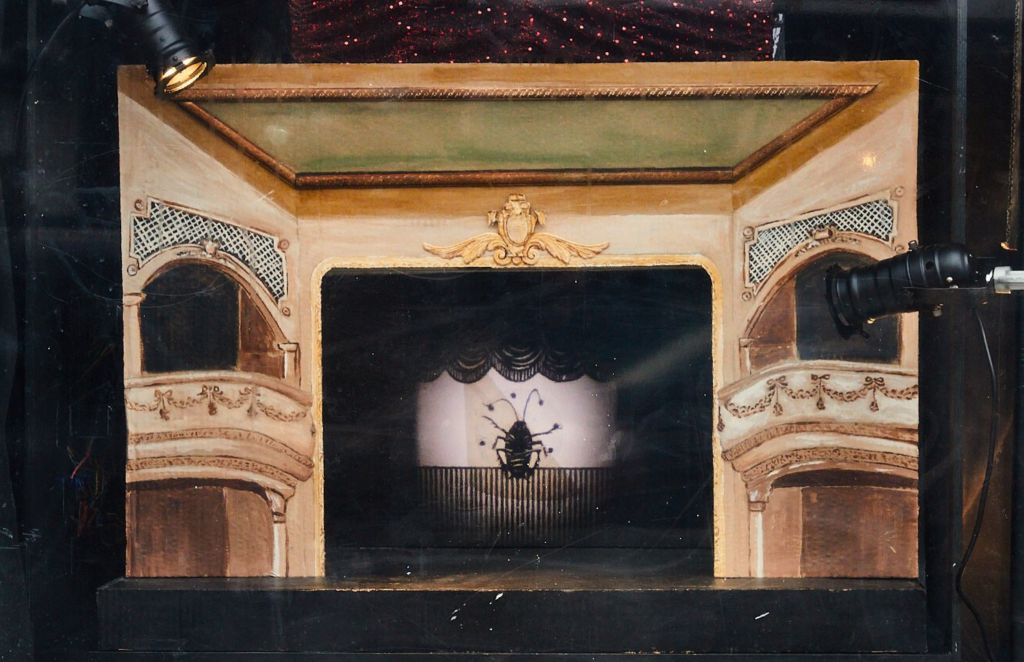
Amour Toujours (détail)
Panneau peint, vidéo avec marionnettes d’ombres découpées à la main
2025
Photo : Laurence Poirier
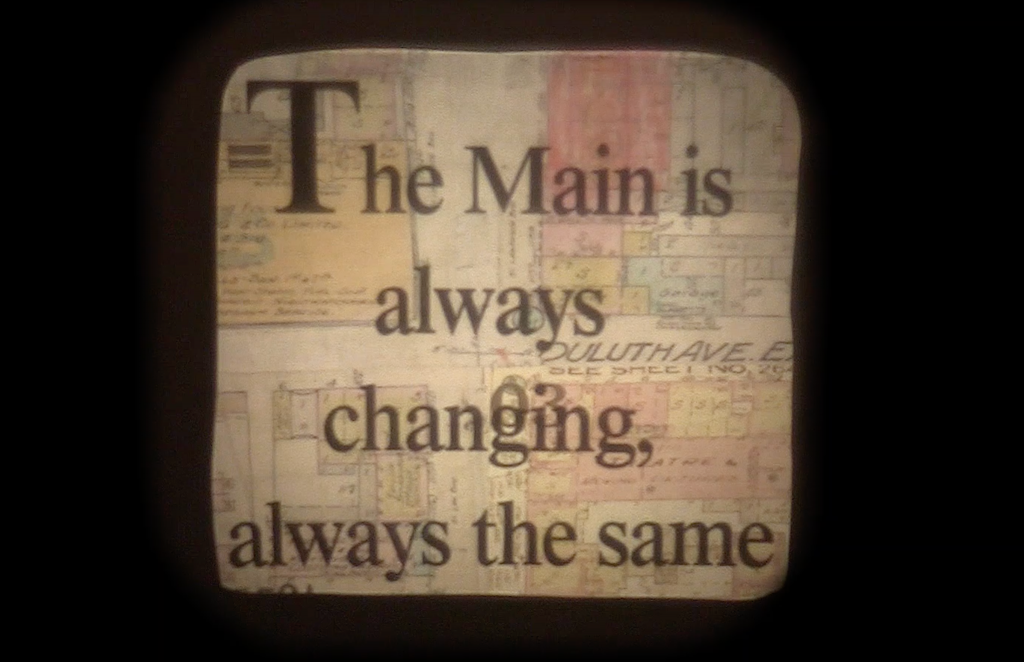
Amour Toujours (vidéo)
Carte d’archives
2025
Avec l’aimable permission de l’artiste
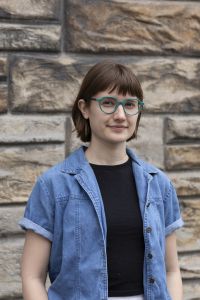 Jennifer Jack est scénographe basée à Tiohtià:ke / Montréal. Titulaire d’un baccalauréat en beaux-arts avec spécialisation en design pour le théâtre de l’Université Concordia, Jen travaille à la rencontre de la scénographie et de la marionnette. Adoptant souvent une approche très documentée de la création, le travail de Jennifer cherche fréquemment à explorer les lieux de mémoire culturelle. S’intéressant à la nostalgie et aux lieux, Jennifer est curieuse des cycles des espaces urbains dans lesquels elle est immergée. Parmi ses réalisations récentes, citons la scénographie de To Pieces (Who Me? Theatre), présentée au Festival Fringe de Montréal 2025, et sa collaboration à Ten Sentences: On the Life of Robert Walser (Mark Sussman/Great Small Works), présentée au Festival de Casteliers 2024. Visitez le site web de Jennifer.
En plus de la pratique artistique, Jennifer contribue à l’organisation de plusieurs initiatives artistiques à Montréal, dont Café Concret et ContraMontreal. Jennifer est une ancienne participante du programme de micro-subvention du Musée du Montréal juif.

Cette installation a été réalisée dans le cadre du programme de subventions du Collectif des arts du Montréal juif (CAMJ), rendu possible grâce au soutien de CANVAS, de la Fondation Azrieli, de la Fondation de la famille Averbach et de la Fondation canadienne des relations raciales.